About
Just want to check them out?
Click here to jump straight to the pedals.
2026/06/29: Photos and Demos Uploading
Some up last night. Some uploading this AM. All will be published today. Thanks!
Designs
-
P-38 🎥✓
-
Phyllis III 🎥✓
🎥✓ = demo
The designs here are all my own or else done in collaboration with D.B. Buchholz
(a.k.a. u/Quick_Butterfly_4571), with the exception of the Economy FETLiner
(which is just a JFET boost + BJT buffer) and the Syndicated OD (which is a
heavily modified OCD with some added bells and whistles).
The P-38 is, in some sense, a Big Muff. The topology is very similar, in that it is a cascade of four transistor gain stages and utilizes diodes for clipping. But, the differences extend beyond just choice of component value, with changes to the topology of the gain control, tone stack, and clipping networks. I wouldn’t be so brash as to call it an original design, but neither is it a clone. It is probably most aptly called an homage.
The schematics for a significant subset of the units can be found in our shared github repo: DIY Pedals Shares.
Artwork
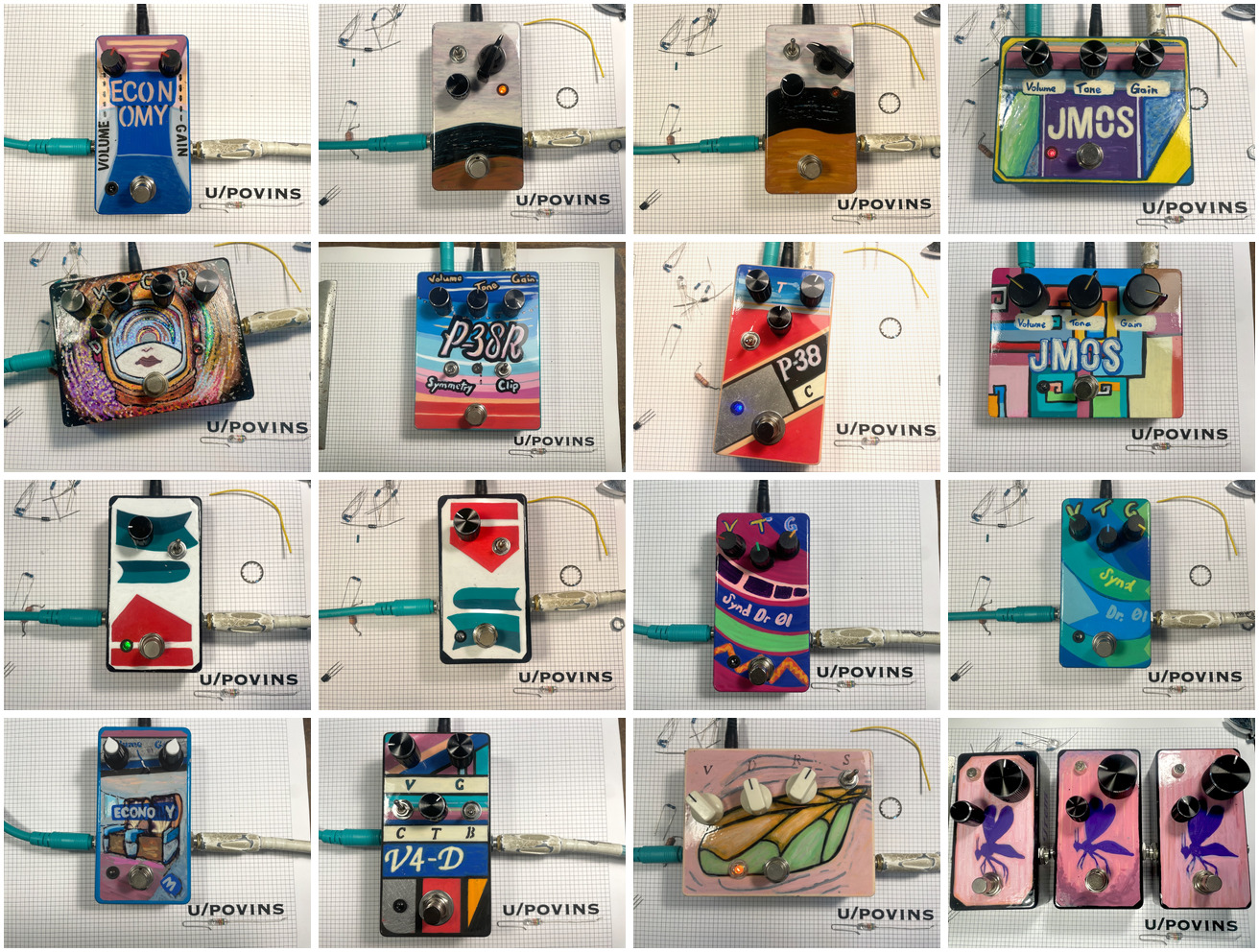
The enclosures are drilled and painted by hand. For the most part, the artwork is acrylic on aluminum with a few generous coats of high-gloss clear coat (it is very durable).
Generally, each run of a specific model has a general style/theme that I adhere to, but there is variation from one unit to the next. I like it that way. Each pedal is a unique work of “art” (I’m not a skilled artist; I’m a prolific and lazy doodler). It’s not very efficient (it’s two coats per dot on the pointalism ones!), but I enjoy it.
Construction
I design PCB’s for the production units and have them professionally fabricated (on occasion, I home etch prototypes or one-off custom designs).
The boards are built using hand-soldered, through hole components (I like to keep things easily repairable / mod-friendly, when space allows).
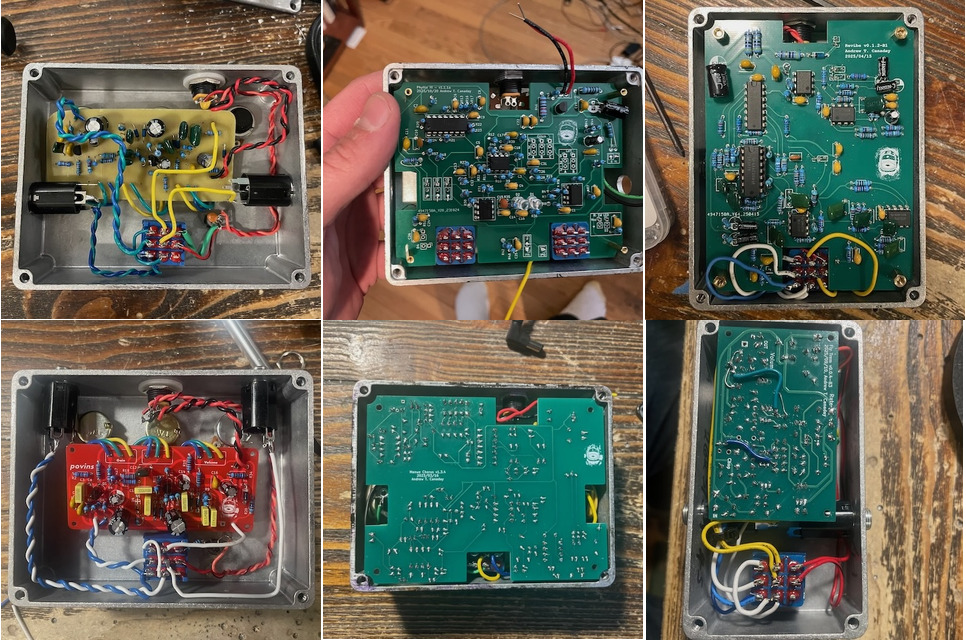
Hardware is wired offboard. Primarily, this is done for design flexibility, but I happen to prefer it for purely stylistic reasons, as well. As a bonus, done properly, it reduces vibrational stress on the solder joints.
Boards are mounted using metal standoffs or else by a combination of geometry and carefully placed rubber bumpers that keep the PCB’s firmly in place.
They are very robust. My oldest units have seen a decade or so of consistent use (studio and stage, passed around at open jams, packed and unpacked, and ferried bout on a regular cadence), and are still chugging along without issue.
Labels
Units with three or more knobs have control labels. Some of the one or two knob units have no visible control labels (some have no top-visible text at all!). These are units that I consider simple enough not to warrant labels. For those:
- Some feature a bottom plate diagram
- Two knob units feature two distinct knobs as a mnemonic.
- All of them come with a short user manual
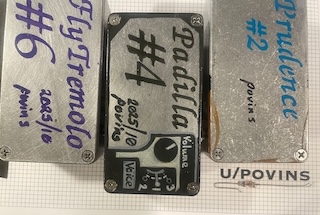
- If the model isn’t printed on the top, it’s on the bottom plate, along with the number.
Numbering
All units have a unit number and date on the interior of the enclosure (this is reproduced on the bottom plate for some units, as mentioned above, but the canonical info can always be found inside the portion of the enclosure that houses the PCB and hardware):
- Prototypes usually just have a date and schematic revision number scribbled inside with sharpie and initialed.
- The first unit of a production-ready circuit is #0. That’s always for me or a bandmate.
- Units given to friends and family are dated and signed.
- Units I sell start at 1 and increase monotonically.
- The only exception is the P-38/C and the P-38R: the serial numbers for sold units begin at #11.
P-38/C and P-38R units #1-10 were handed out to different musicians to experiment with and provide feedback. They were all patched and recycled many times over until the circuit was finalized.
Models
-
JMOS: JFET/MOSFET single-ended tube amp grit.
-
The Fly Trem: Simple, artfully colored, 60’s style, gain modulation tremolo.
-
P-38: An homage to the Big Muff and my all time favorite dirt.
-
Padilla: Maximum crunch, zero noise, fuzz.
-
V4-D: Flexible overdrive with pre/post EQ, frequency-dependent crunch, and a low-end boost switch.
-
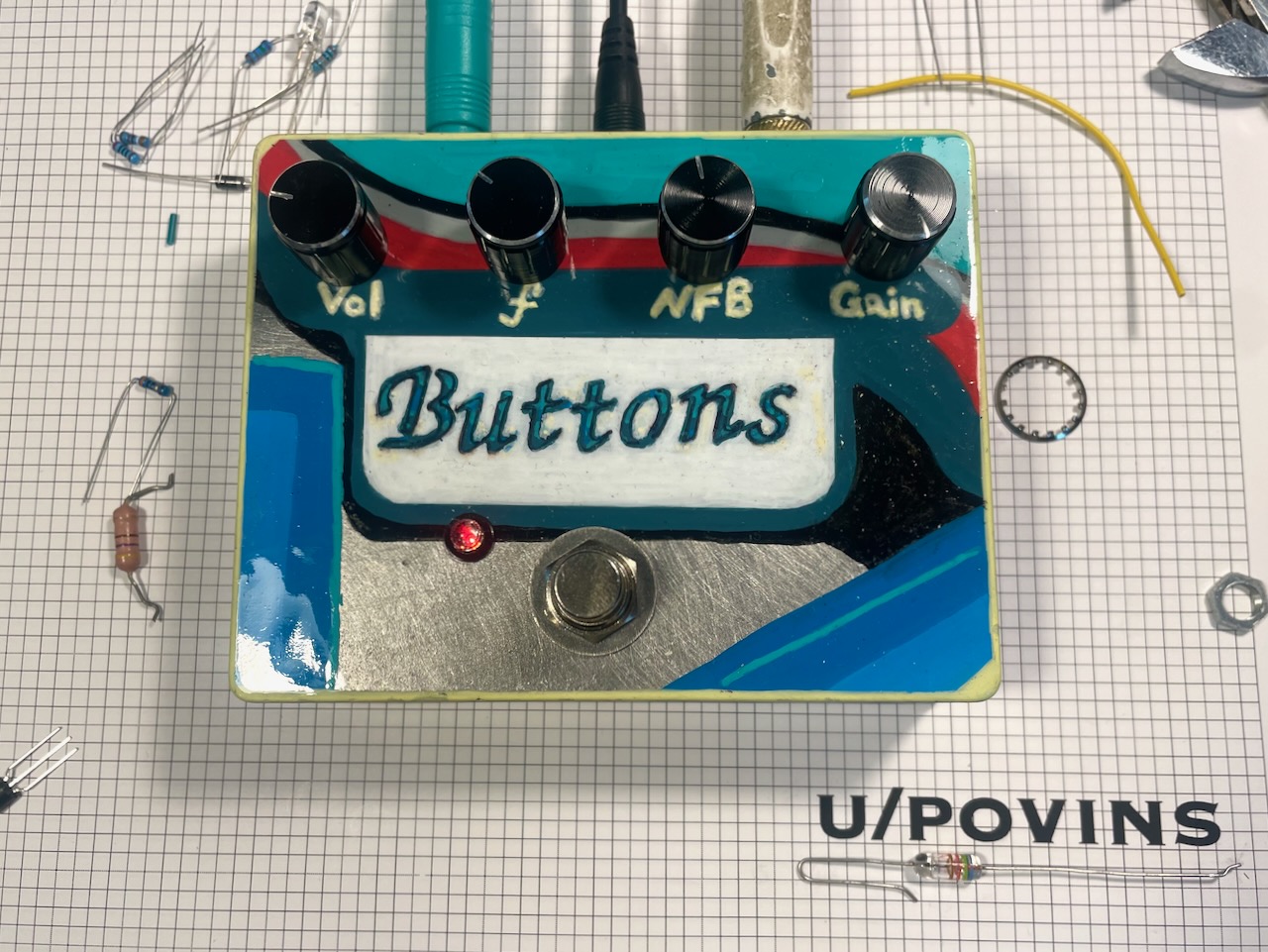
Buttons: A cascade of four JFET gain stages. Controls for gain, linearity, and tone.
-
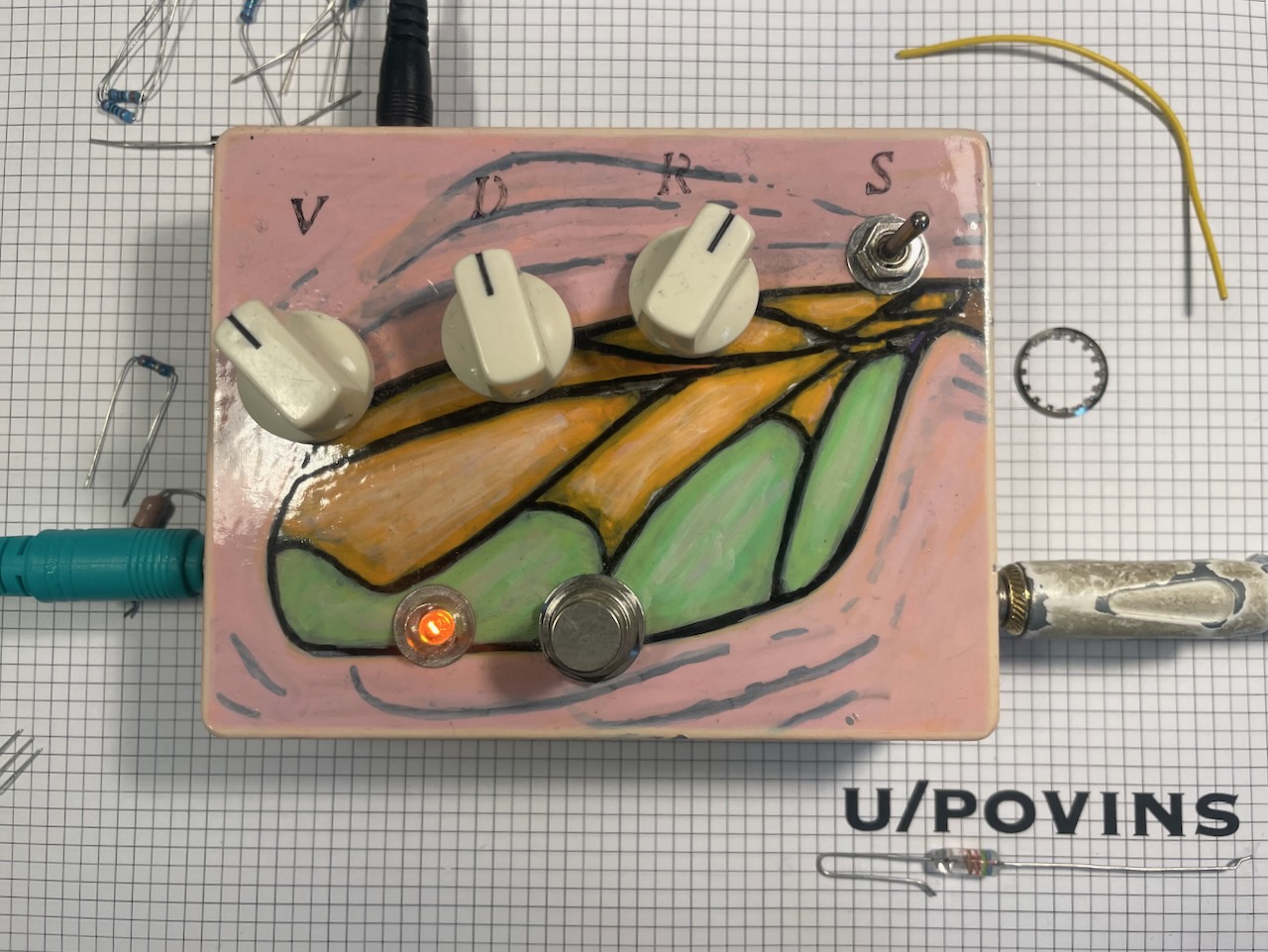
Fly Trem Deluxe: Fly Trem with adjustable depth, wave shape, and wider range of speeds.
-
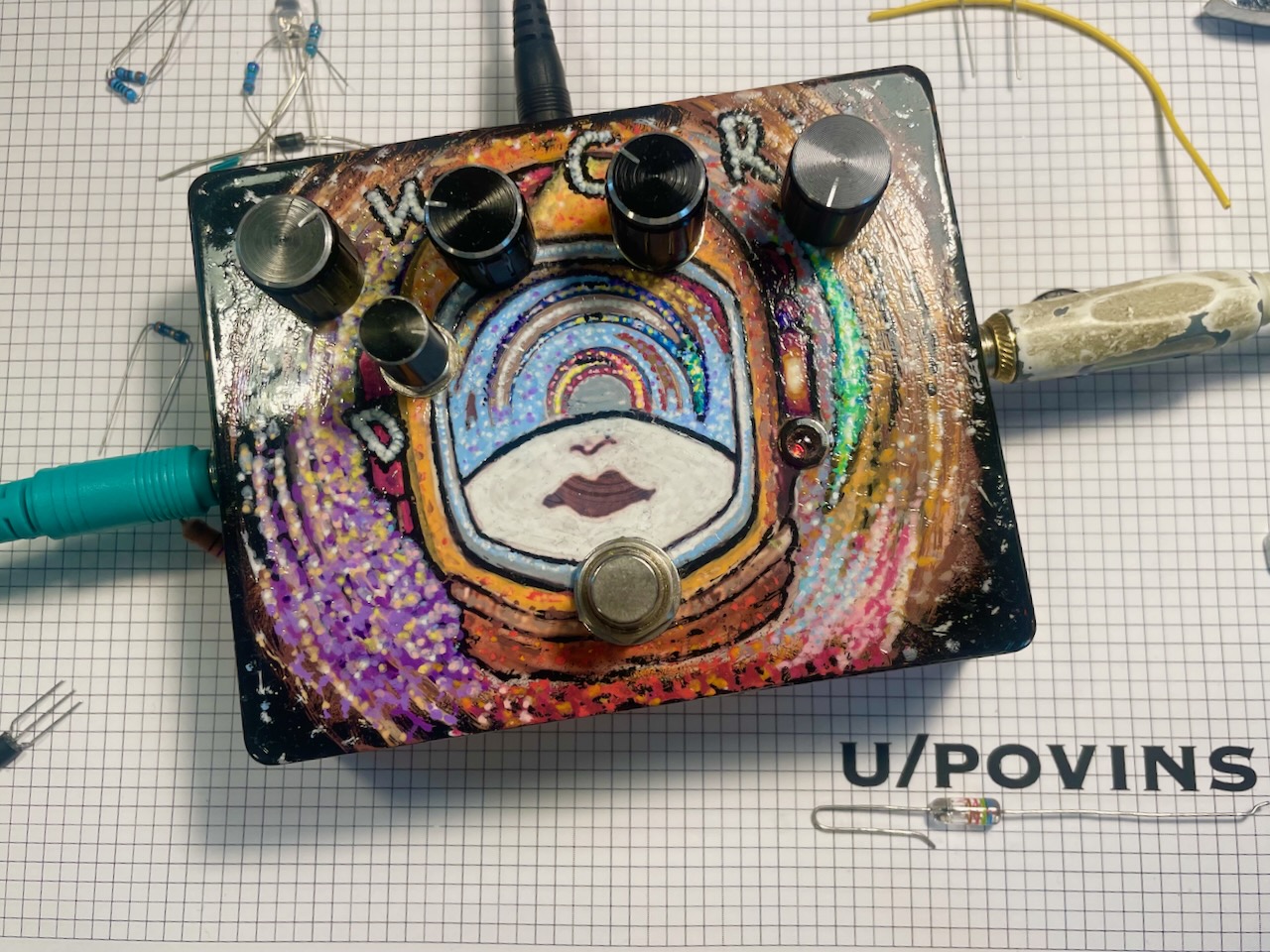
Manwe: Insanely flexible BBD chorus. My favorite of all time.
-
Phyllis III: Synth fuzz, overdrive, two sub octaves, a mixer, a lead channel, and glitch mode.
-
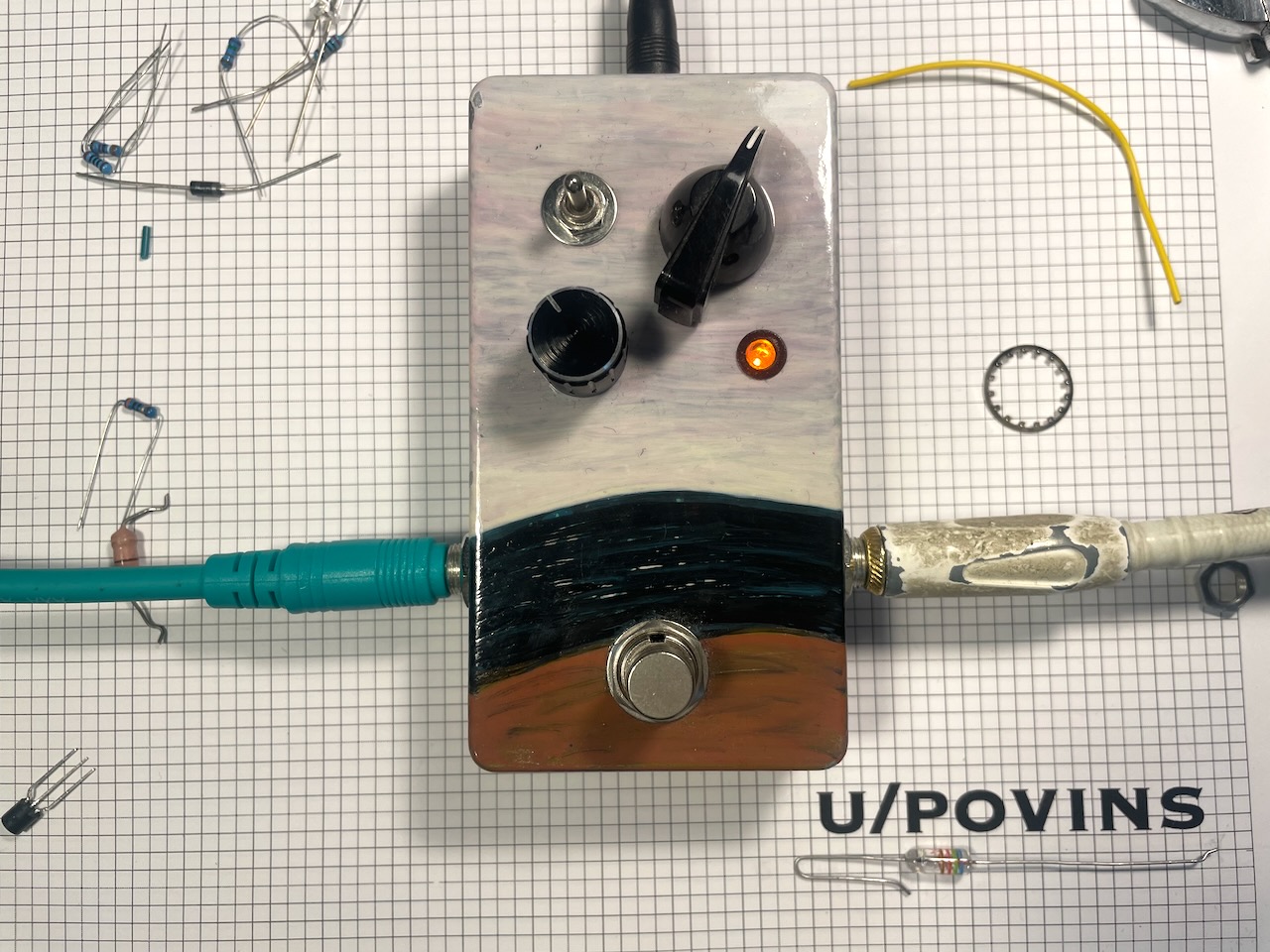
Prudence: Do one thing and do it well: late 60’s lead tone with two knobs and a compression switch.
-
Economy FETLiner: JET gain. BJT buffer. Gain. Volume. Simple and useful.
-
Yup! Mini Grit: One knob, BJT and LED, mid / treble booster.
-
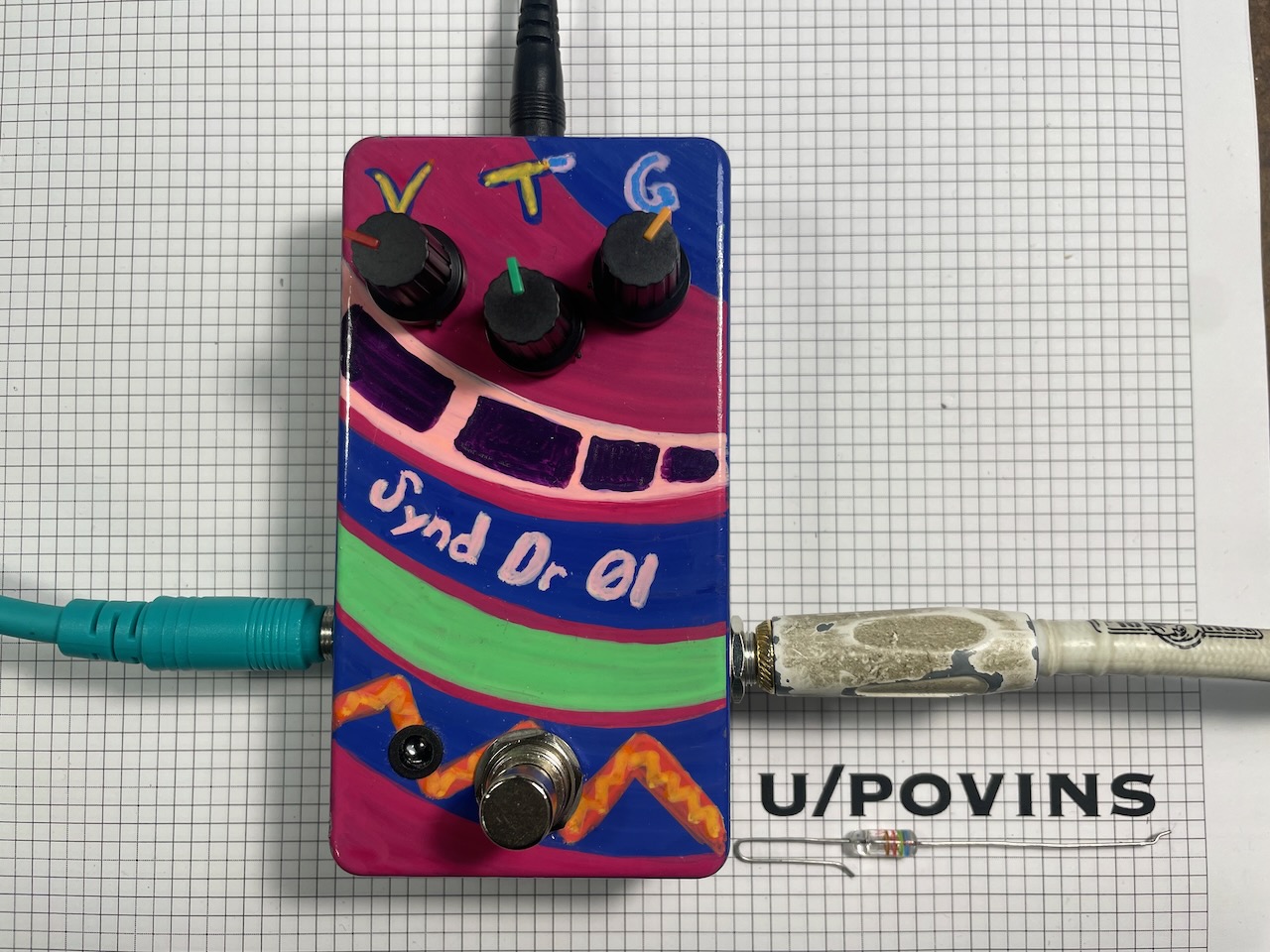
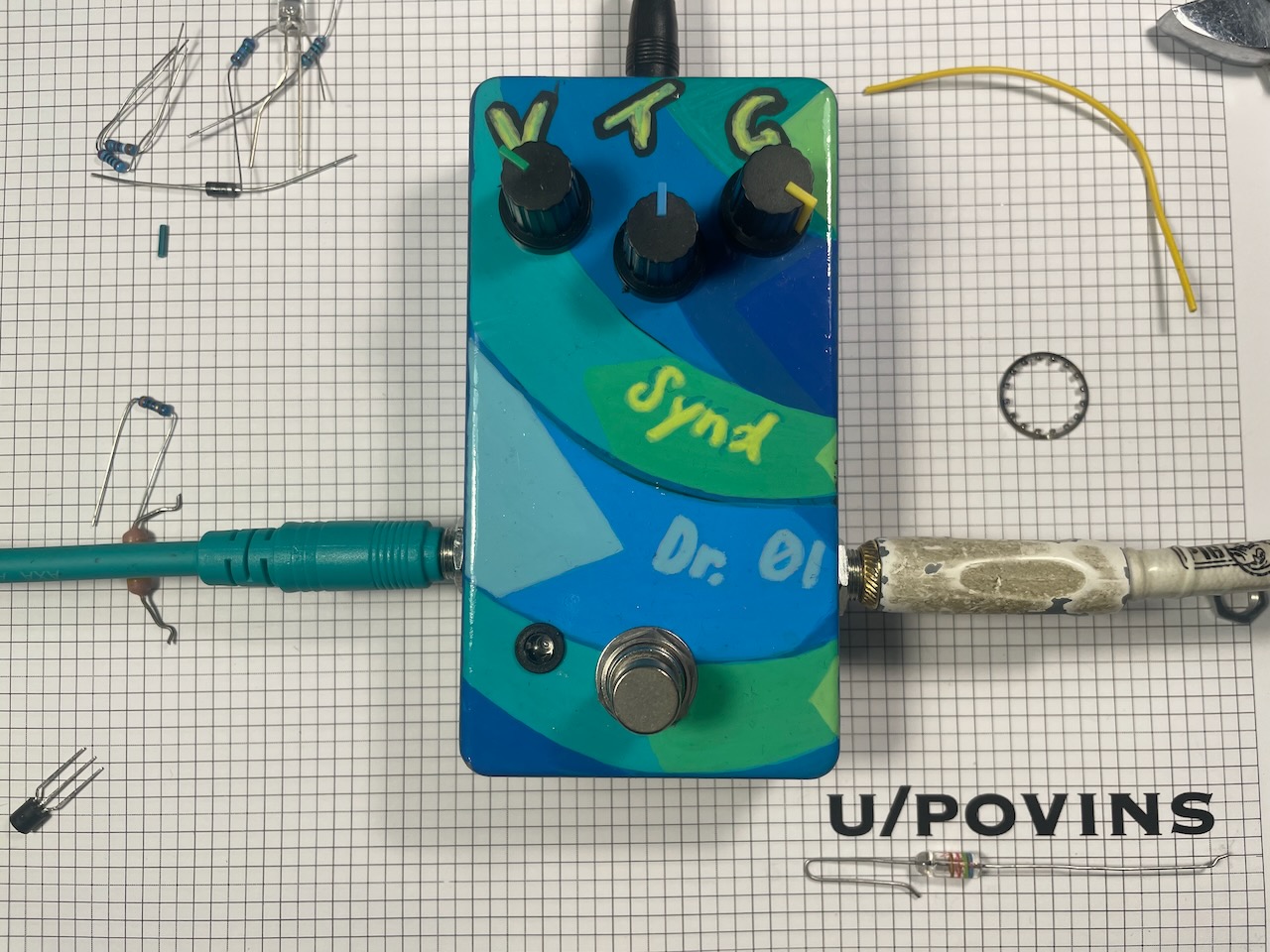
Syndicated Overdrive: An OCD with more harmonically rich crunch and a flexible EQ.
JMOS
JFET/MOSFET single-ended tube amp grit.
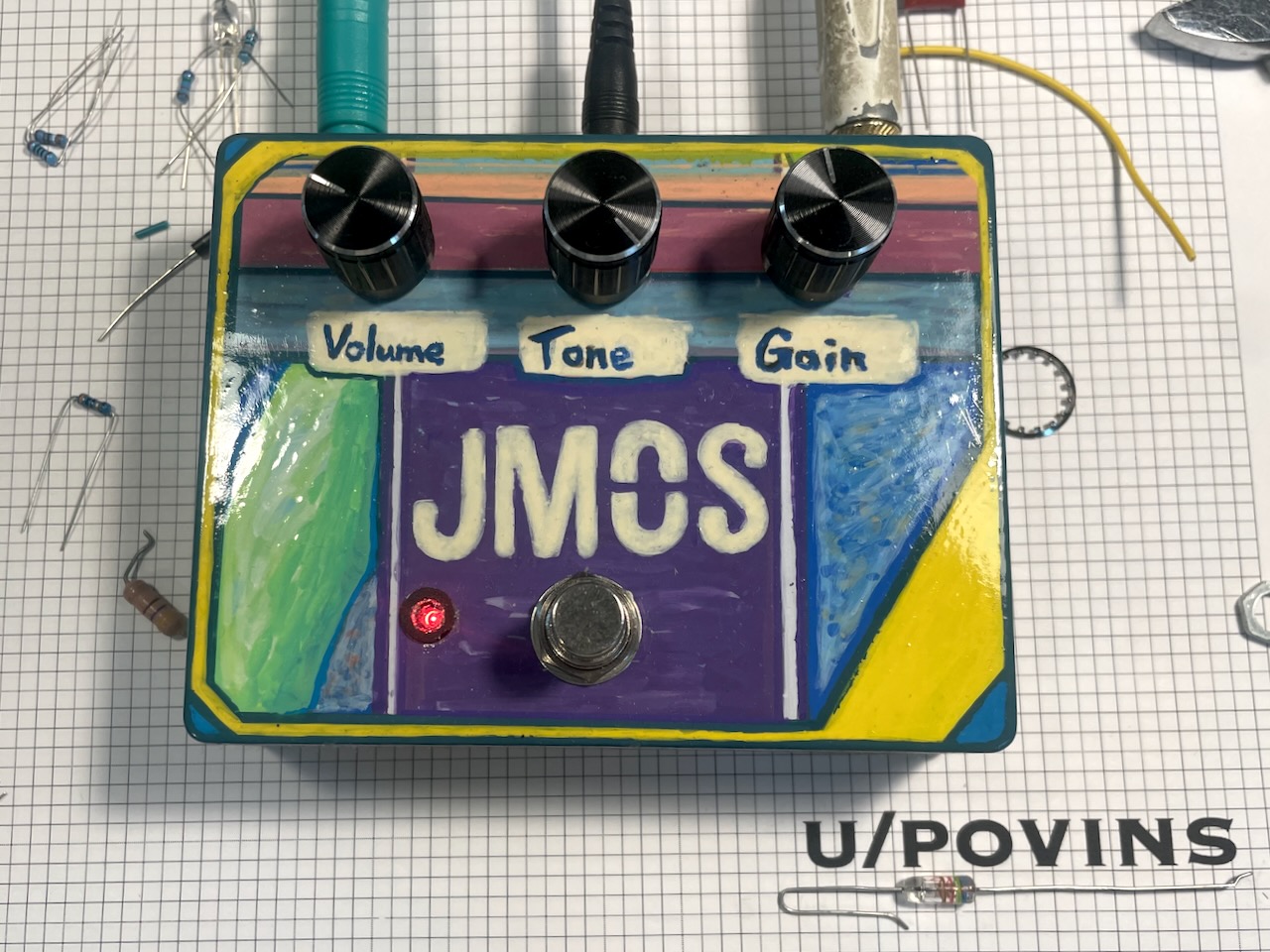
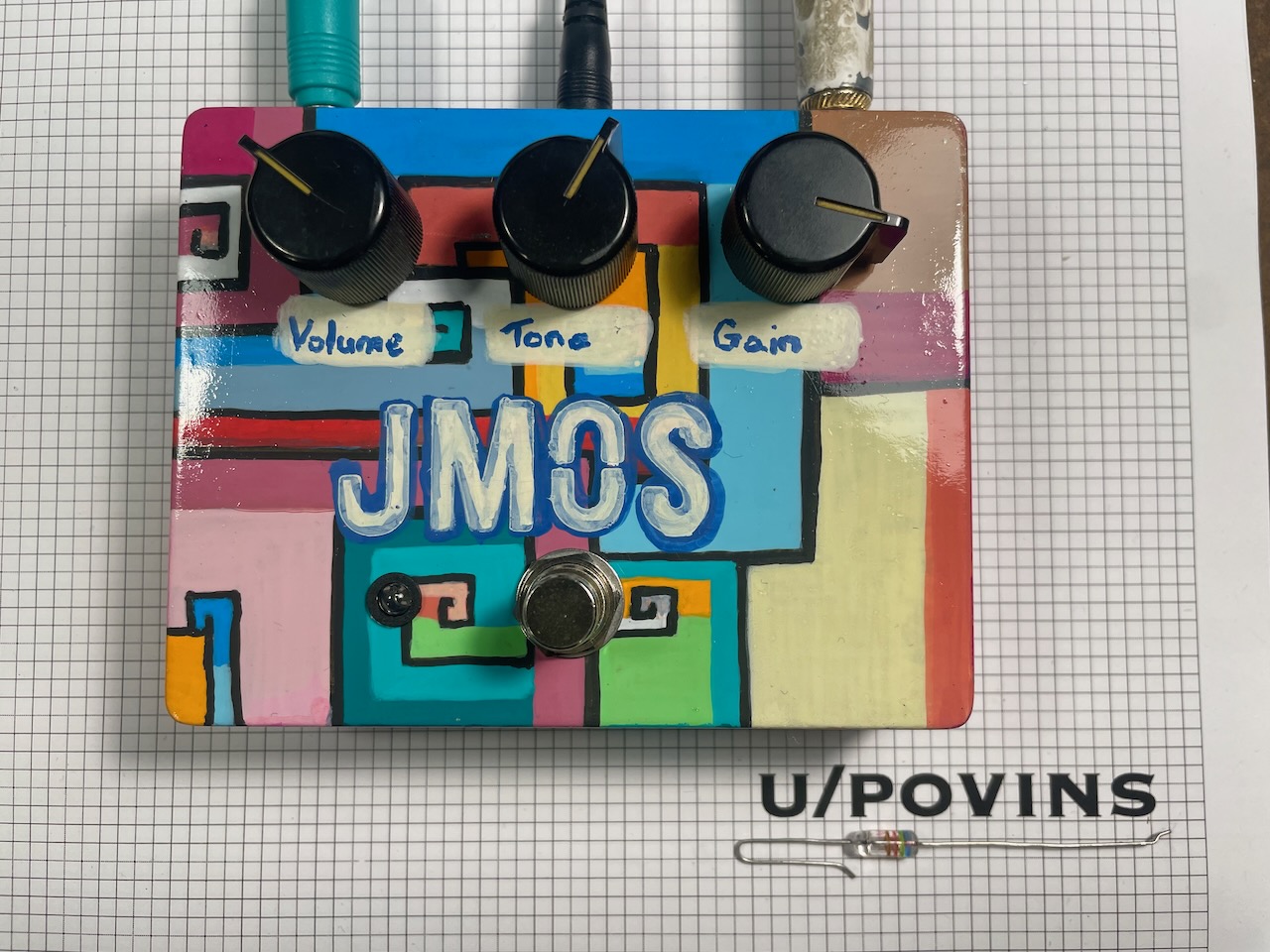
A.C. (povins)
I built myself a little single-ended tube amp out of furnace parts and oddball tubes that I found in bins at the local ReStore.
As it turns out, it’s one of my favorite amps of all time. The crunch that you get out of it if you push it is simply unreal.
The JMOS is designed to replicate some of the behavior of that little tube amp.
Inside are cascaded JFET and MOSFET stages. The JFET provides some gentle compression that varies with gain and signal amplitude. The MOSFET stage provides similar clipping characteristics to the 6CM6 beam tetrode in that random-parts, single ended, tube design.
Situated between is a network of elements which mimic the effects of grid bias shifting for DC coupled tube stages and an unconventional, nonlinear tone stack: the operation of the filter is approximately exponential. This causes the tone setting to be more pronounced at higher amplitudes, which helps recreate the emphasis on the fundamental that is produced when a pentode or beam tetrode is pushed to the fringes of its operating frange.
Rounding out the portrait, the MOSFET stage is biased with a network of elements that provide a highly nonlinear gain curve for limited band of frequencies when the stage is pushed hard. This was done to emulate the band-limited, spikey, intermodulation distortion produced by a single ended output transformer going into saturation.
To be frank, I was skeptical during the design phase that there was worth in chasing what seemed like minutiae. I built the first prototype in 70’s fashion by painting traces by hand on a copper clad board and etching at home.
An hour after powering on the prototype, I was busy designing the PCB’s for the units you see here.
I think it’s a total joy. I’m hopeful you’ll think so too.
The Fly Trem
Simple, artfully colored, 60’s style, gain modulation tremolo.
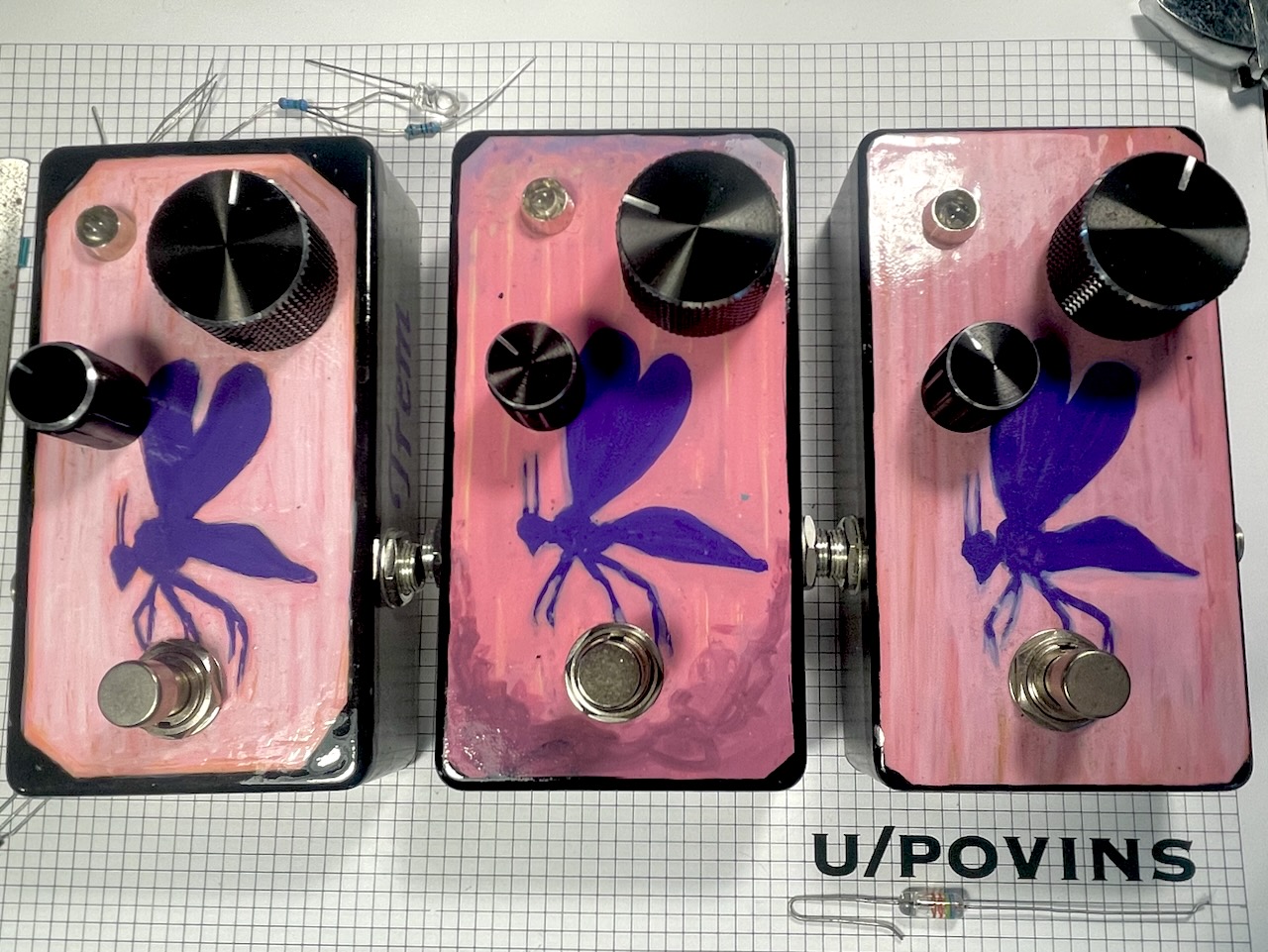
D.B. (QB)
The Fly Trem is a “do one thing and do it well” tremolo, designed in the fashion of 60’s tube amp tremolos. It provides a rich, old-school, pulsating, amplifier-style tremolo with a delicately applied vintage voicing.
The effect uses a phase-shift oscillator to generate a click-free, thump-free, sine-wave LFO that varies the gain of a phase-inverter. It is clean, but not 100% transparent: the circuit imparts a hint of vintage voicing to provide an authentic, old-school, tremolo sound.
In a final nod to the tremolos of that era, the phase inverter has been designed to compress when overdriven. If preceded by a boost, distortion, or OD, rather than rail-clip, this tremolo provides gently rounded, asymmetrical clipping, typical of an overdriven triode phase inverter.
The debut version is the “compact”, featuring two controls, rate and volume, and buckets of undulating goodness.
This one actually has its genesis in someone in r/diypedals asking if there were any schematics for a good, all-BJT, tremolo. I designed this trem for the reply. In retrospect, I think they had also asked for something that was simple, and this unit fails that requirement: it’s ten BJT’s packed onto that little board, four of which should be approximately matched pairs.
There is a simpler, four-transistor, follow up — “The Gnat” — which is included in the shares repo, along with the Fly Trem.
P-38
An homage to the Big Muff and my all time favorite dirt.
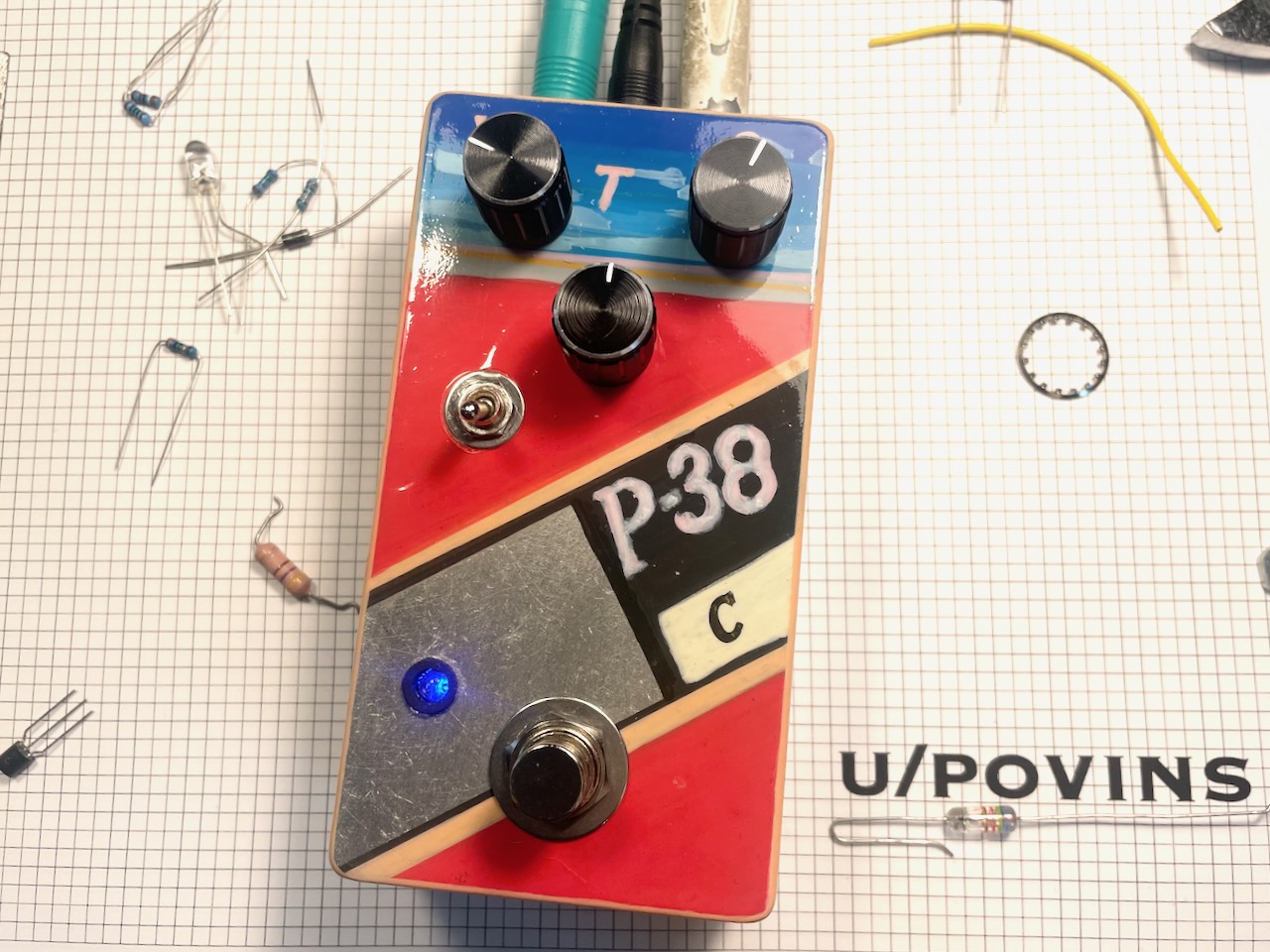
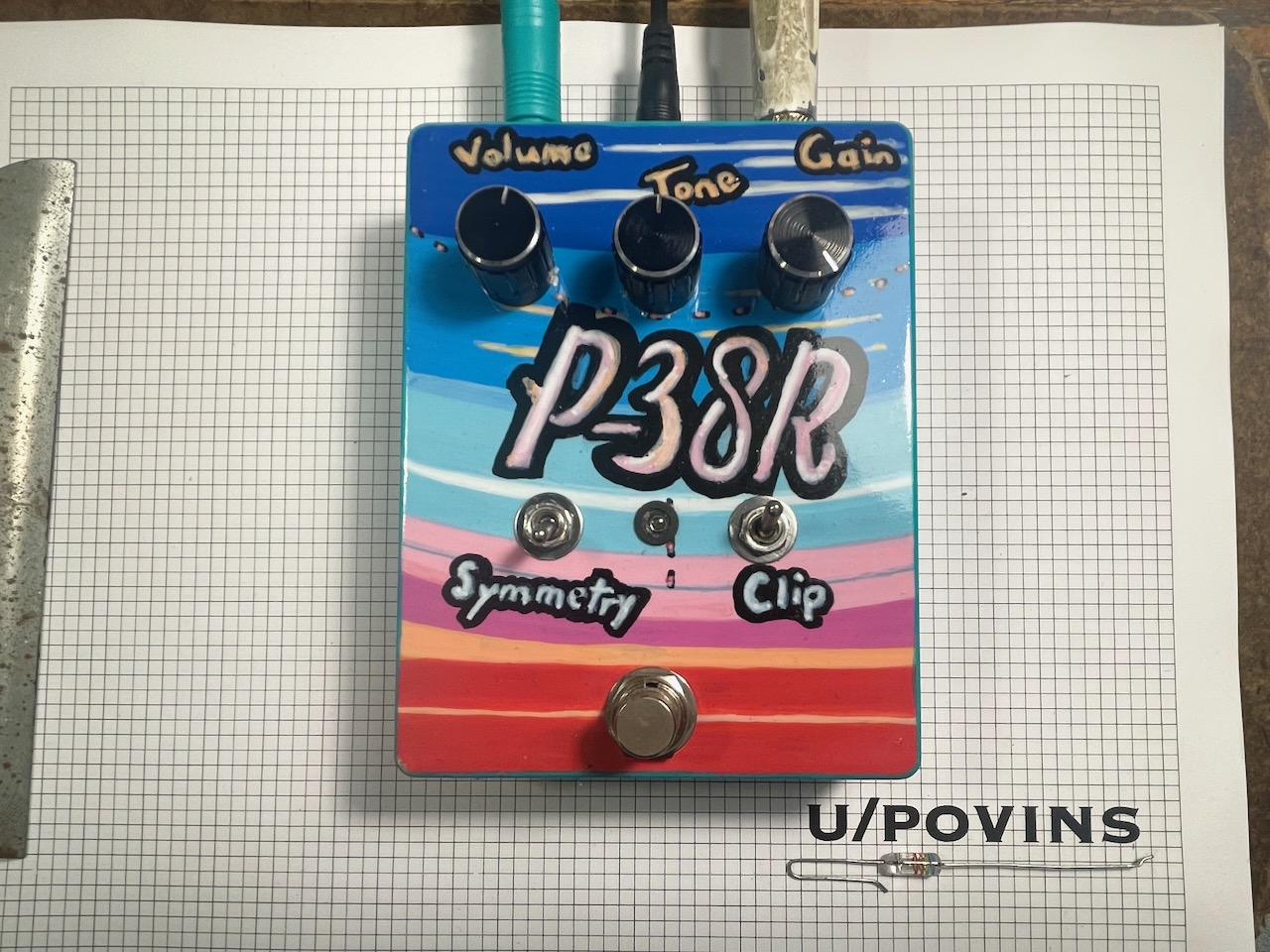
A.C. (povins)
This pedal uses the basic Big Muff structure, with changes to the gain, clipping, and tone control topologies. The clipping stages are made asymmetric by the addition of some old germanium diodes that I inheretted (the “C” unit has seven diodes, altogether. The “R” unit — not shown here — has nine, five of which are germanium1.
Rather than toggling what type of diode is used in the clipping, the P-38 allows the amount clipping applied to different frequency bands to be adjusted via the three way toggle. The differences are not subtle. It feels like three different pedals, and there is utility in it, e.g.: disproportionately clipping highs results in a high-end compression that suits a guitar part that is carrying the bottom end. Heavily clipping the lows provides quite a heavy crunch that won’t step on the base.
The middle ground is maybe a little self-indulgent. It is my favorite.
Toward having a more usable range of EQ, rather than being an HPF/LPF mix control, the tone knob adjusts the phase rotation and relative weight of two copies of the signal — yielding usable tones across the full range of the control, at the expense of less extreme extremes.
It doesn’t facilitate “muffled” lows or “sack of razorblades and tin” highs (I’m not knocking those, either! Sometimes, those are exactly what you want! I get it!). It is designed to produce a fairly wide range of distortion tones that range from “fat” to “cutting.”
The natural tone of the guitar can shine through or be compressed out almost entirely, depending on the gain setting. The clipping stages have a higher LPF cutoff than is typical of Muffs and Muff clones. This allows for some really gnarly pinch harmonics, but is still low enough to prevent the screaming, high-frequency, feedback when nothing is being played.
I think it sounds pretty great.
Demos
Padilla
Maximum crunch, zero noise, fuzz.
D.B. (QB)
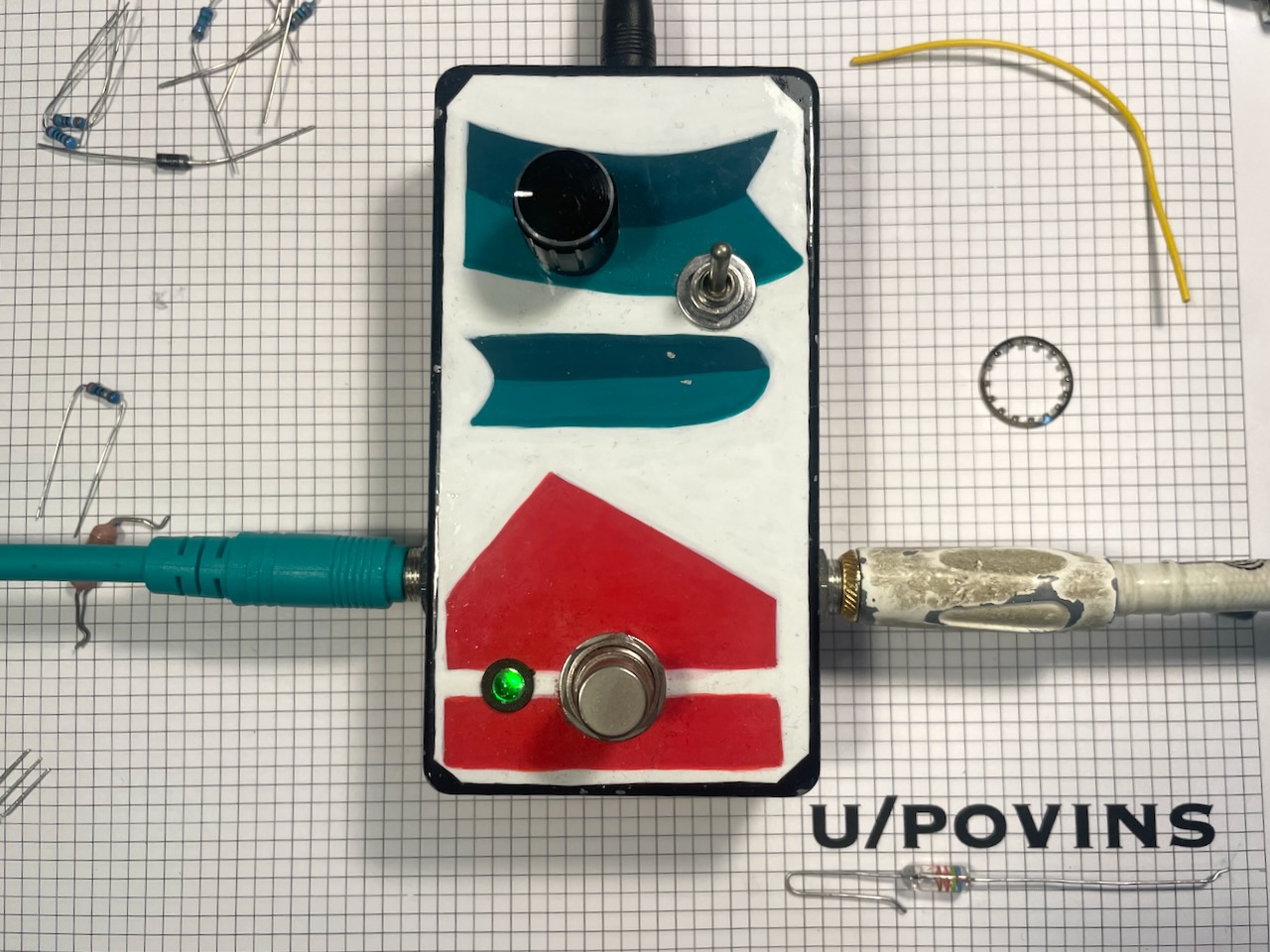
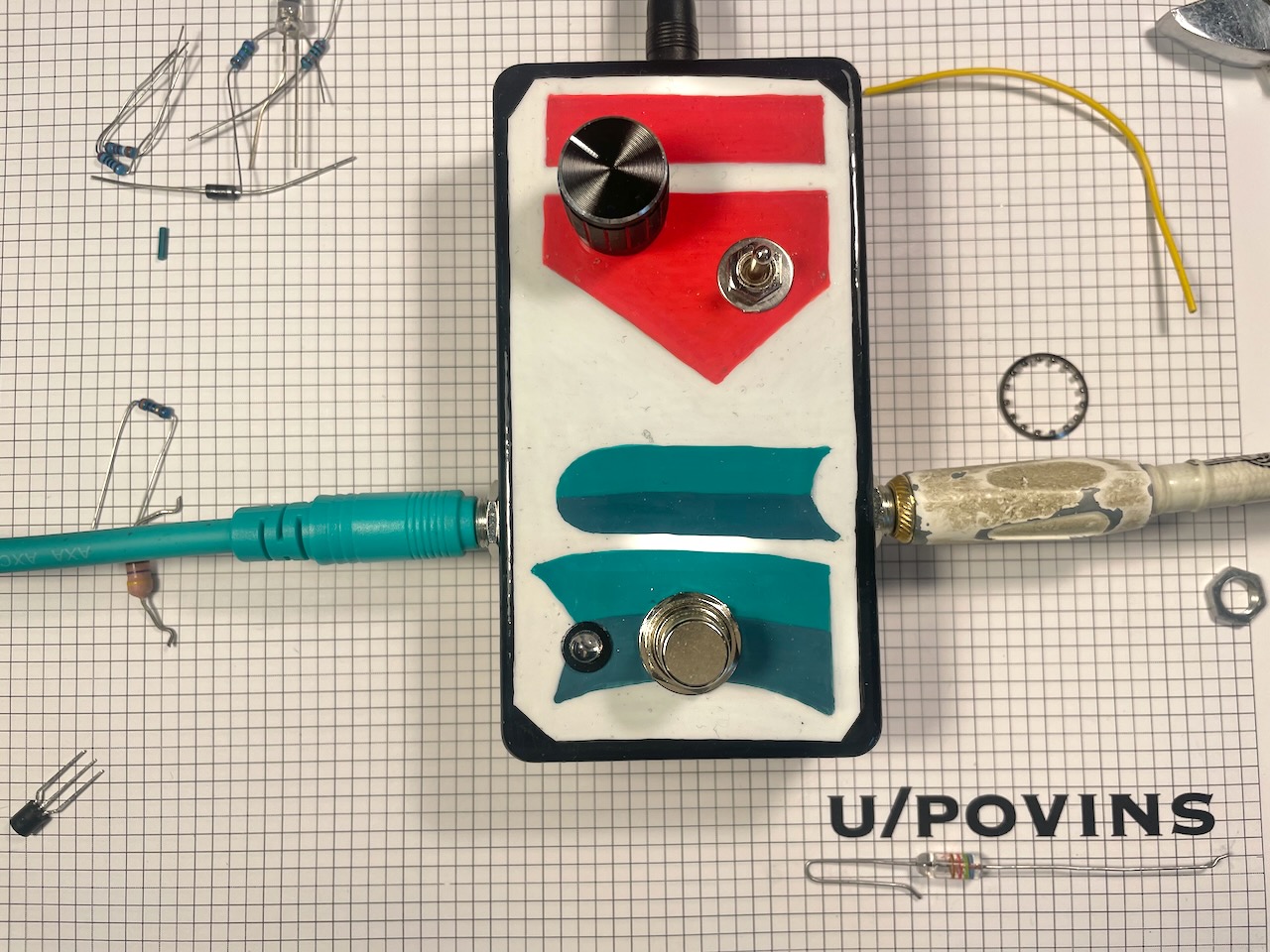
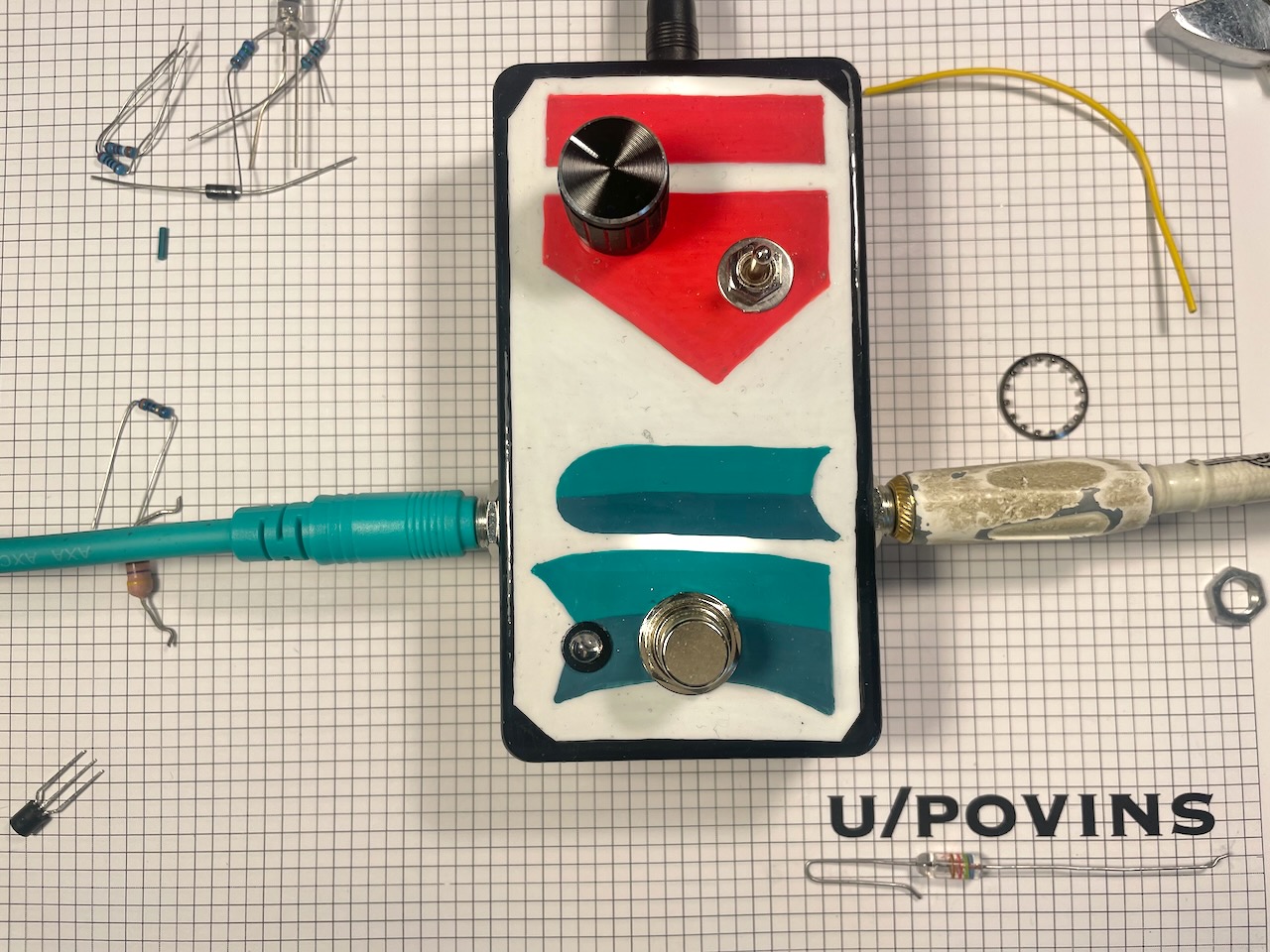
I’ve referred to the Padilla as a “square wave fuzz”, but only because that label commits the fewest lies of omission. The truth is, the waves aren’t square, and the Padilla really is its own thing. I’ve been doing this for decades, and I don’t know exactly what to call it. All I can tell you with certainty is this: It is an oddball, and I love it.
So, instead of trying to tell you what it is, I’d like to tell you what it does. I hope that works for you because this page only facilitates one-way communication, and technically I am in your past.
The distinguishing feature of the Padilla is this: every note hits with maximal gain and compression — crisp and harmonically rich like an amp with the pre and power stage pushed to the edge of going molten — and makes no noise at all, otherwise.
There is no idle hiss or hum and no sizzling jagged edges between notes. You don’t have to place fingers across strings to keep it quiet. It is a discerning, all-or-nothing, face melting machine. This isn’t because it has a noise gate. At its core, the Padilla knows full well what things are notes and what things are not. And, it cares not a whit for anything that isn’t a note.
The Padilla is an all discrete, transistor, design — the core of which was designed by borrowing the topology of an IC produced by National Semiconductors at the dawn of the 1970’s, stripping it down, and twisting it into something it was never meant to be: the National Semiconductors device compares signals and produces a tidy binary output. The padilla compares an input to itself and roars for guitar and ignores everything else.
The output stage performs some wave-shapping to keep round edges a little round and modulate the signal in proportion to the frequencies it contains — accentuating harmonics and preserving timbre. It provides more compression than a distortion, is more organic than a synth fuzz, and is tighter and less wooly than a traditional fuzz.
Designed as a “do one thing and do it well” pedal. The controls are minimal. There is a three way toggle that selects a voicing — rhythm, flat, or lead — and a volume control. It has tons of sustain and, at best, all anything else can do is match its crunch. I dig it. I hope you will too.
V4-D
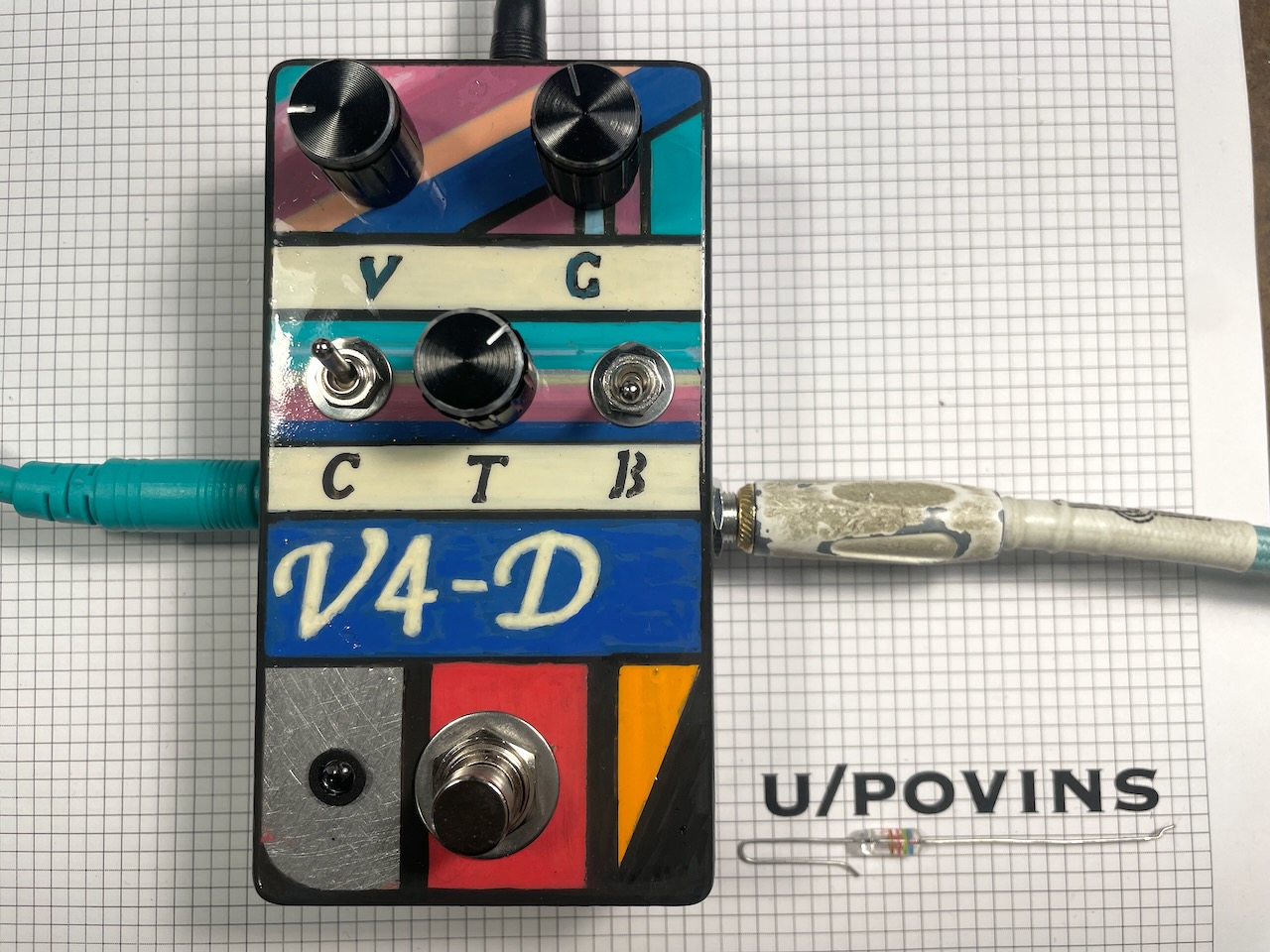
Flexible overdrive with pre/post EQ, frequency-dependent crunch, and a low-end boost switch.
A.C. (povins)
I brought it to the studio and put it on my board. The next time I went to the studio, it was on the other guitarist's board.
When I designed the first PCB for the Syndicated OD, I went overboard. I added all kinds of bells and whistles, places for extra switches and knobs, and jumpers to allow me to change the topology — to make different pedals entirely using the one board.
Well, it was too big to comfortably fit in a 1590B, so I redid it. I made smaller, focused, circuit boards for the Syndicated OD.
That left me with a set of “whatever overdrive you like,” boards.
So, I took one of these and outfitted it with a different clipping configuration, changed the gain, added pre and post clipping EQ, and put a low-end boost toggle for the first gain stage to allow it to be used as cutting overdrive or a roaring distortion. I brought it to the studio and put it on my board. The next time I went to the studio, it was on the other guitarist’s board. So, I built another for me. They’ve both seen steady use for a couple of years now.
It’s amazingly flexible. If you decide you want a different overdrive: you already have it.
It’s not a revolution. It’s a shape-shifting workhorse.
Buttons
A cascade of four JFET gain stages. Controls for gain, linearity, and tone.
A.C. (povins)
Buttons is drive pedal. It is an unusual drive pedal.
It consists of a cascade of four JFET gain stages with an input gain control with adjustable global feedback and a feedback frequency band filter.
That is: it’s a dirt pedal that allows you to tailor the linearity and compression of the distortion to taste.
“What does that mean?”
- It can be used to push an amp into overdrive.
- It can be overdriven itself.
- You have complete control over the amount of touch sensitivity.
It can be made to go from “edge of breakup” to “full on roar” using picking dynamic alone, or you can dial in and pin a specific amount of breakup that varies little with playing intensity.
It started as an experiment. I loved it (honestly, the exhaggerated dynamics with the negative feedback less that 12 o’clock are too fun). I was making PCB’s within a few hours of plugging the first one in.
Fly Trem Deluxe
Fly Trem with adjustable depth, wave shape, and wider range of speeds.
A.C. (povins)
When I designed the PCB for the Fly Trem, I added a couple inlet points for extras. This is the same Fly Trem core with the addition of:
- A depth knob
- A mode switch
There are three modes:
- Standard Fly Trem (Center)
- Helicopter (Down): I added this to get that hard, start-stop, slow tremolo sound — the kind featured prominently in some late ‘90’s rock (ala The ButtHole Surfers’ Pepper ). The effect is less round and the oscillator speed is decreased, to provide that helicopter blade chop.
- Shimmer (Up): The LFO frequency is shifted to be faster, the tremolo curve is a pure sine wave, and the amplitude is slightly reduced. This setting is a great way to leverage the tremolo for texture rather than as a rhythmatic element.
Manwe
Insanely flexible BBD chorus. My favorite of all time.
A.C. (povins)
This is my favorite chorus of all time. It is lush and insanely flexible.
A chorus pedal works by mixing together your dry signal with a delayed copy and cyclically increasing and decreasing the amount of delay applied to the copy using and LFO. The quintessential chorus pedal has a rate, depth, and volume knob. Rate changes how fast the delay speed is cycled, and depth (when present) usually either adjusts the range over which the delay is varied or adjusts the wet volume at the end mixing stage.
The Manwe gives you individual control over everything involved in the chorus effect:
- Rate: changes the LFO speed
- Center: sets the midpoint for the delay
- Wobble: determines how far behind or ahead of the midpoint the delayed signal can be
- Depth: determines the amount of wet signal added in to the final mix at the output stage
This allows the unit to do everything from gentle flanging to subtle doubling, and to reproduce the chorus textures from a wealth of different units covering many decades.
It’ll do a subtle undulation, reminiscent of a Leslie cab at high speed, the lush, warm, long-delay chorus of the Small Clone, the tight and bright backing of a CE-2, and the natural chorus of parallel stacks in an 80’s arena.
The maximum “Center” and “Wobble” positions allow you to superimpose a heavily modulated, seasick, warble that can be eerie or quirky, depending on application.
Phyllis III
Synth fuzz, overdrive, two sub octaves, a mixer, a lead channel, and glitch mode.

A.C. (povins)
I designed this pedal to allow me to recreate the synth tone from an old song of mine on the guitar. It derives five different signals from the input — an overdrive, two square wave fuzzes with slightly different duty cycles and frequency responses, and one and two octaves down. The output stage is a mixer with some frequency-dependent gating that adds some permutation of four of the five channels.
It has a “glitch” mode that pits the two square-fuzzes against each other to drive the suboctaves. In glitch mode, the attack and harmonics influence which of the two fuzz signals gets through the gate. The result is some lovely glitchy breakup that dances between the fundamental and even harmonics thereof as you play.
Each of the derived signals is filtered differently on the way out, shaving off some of the harsh higher-order harmonics. This provides a rich, bassy, synth tone without a lot of “tin.”
It’s a lot of fun.
The artwork on each was made by covering the enclosure in black caligraphy ink, waiting for it to set, and scratching out doodles and control labels using a small screwdriver.
Demos
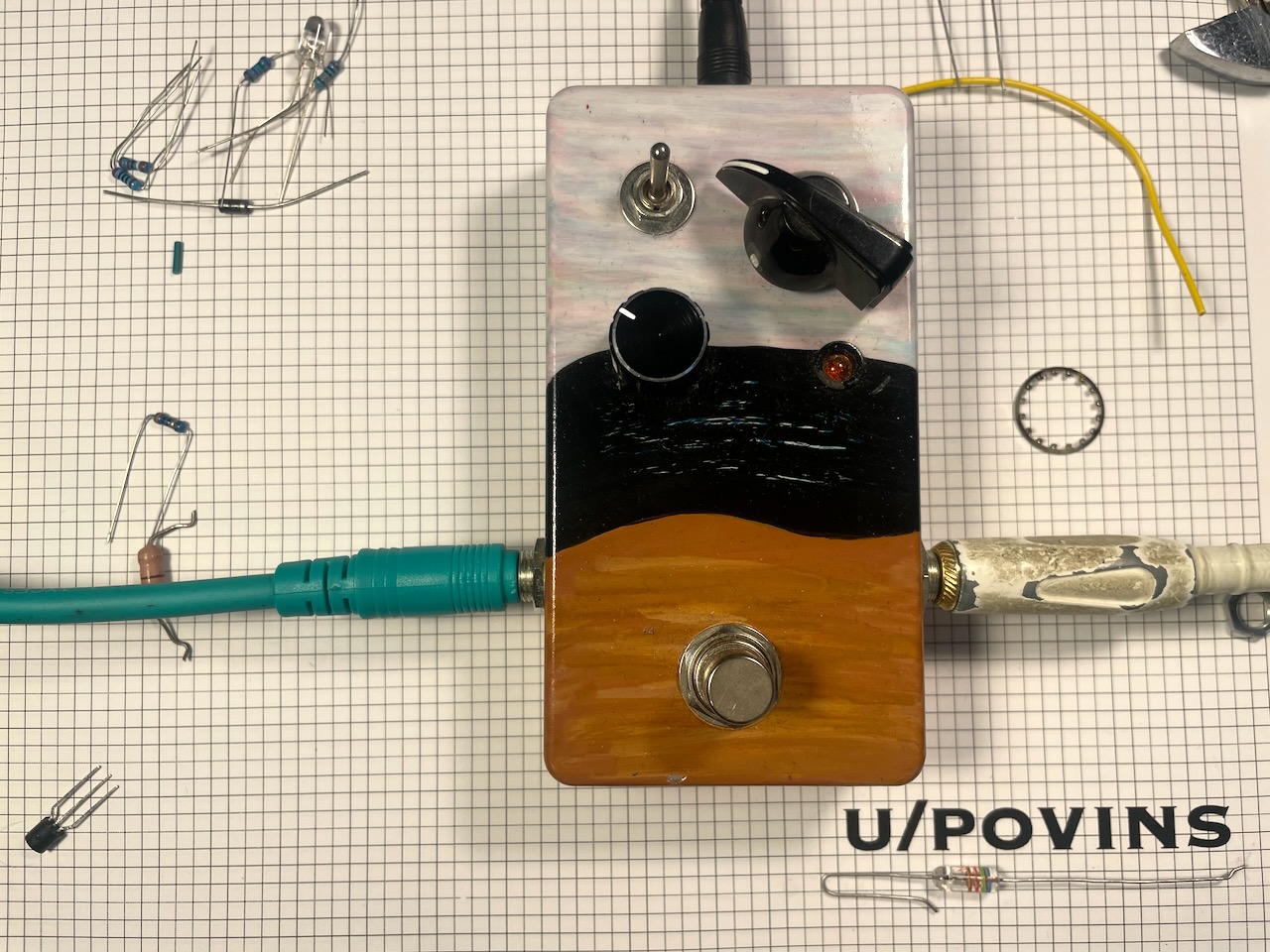
Prudence
Do one thing and do it well: late 60’s lead tone with two knobs and a compression switch.
A.C. (povins)
The last of this latest run of “do one thing and do it well” effects: the prudence is a late 60’s lead tone in a box.
There are three controls:
- presence / tone: rather than filtering or applying EQ, this actually adjusts the frequency response of the two internal gain sections. The range isn’t huge, just enough to emphasize low, mids, or highs but the character of the effect remains essentially unchanged.
- three-way compression toggle:
- center: no compression
- down: some compression
- up: maximum compression
- volume: does what you’d expect
The idea here is that the pedal is providing a very specific character of dirt with just enough added flexibility to work in a variety of lead or rhythm roles in the context of a band.
You select a range of frequencies that get maximum grit using the presence knob, determine the dynamic range using the compression toggle, and you’re off.
The guts of it are a cluster of BJT’s arranged almost as if they were the output stage of a push-pull poweramp, but the design is intentionally broken: rather than working together to maximize power delivery, the two halfs work against each other in an amplitude and frequency dependent way.
The result of this is gain with a bite, rather than a crunch, and a tone that is reminiscent of lead lines on some big hit albums from the last few years of the 1960’s.
I only expected to make one for myself, but it turned out to be a surprise hit.
Economy FETLiner
JET gain. BJT buffer. Gain. Volume. Simple and useful.
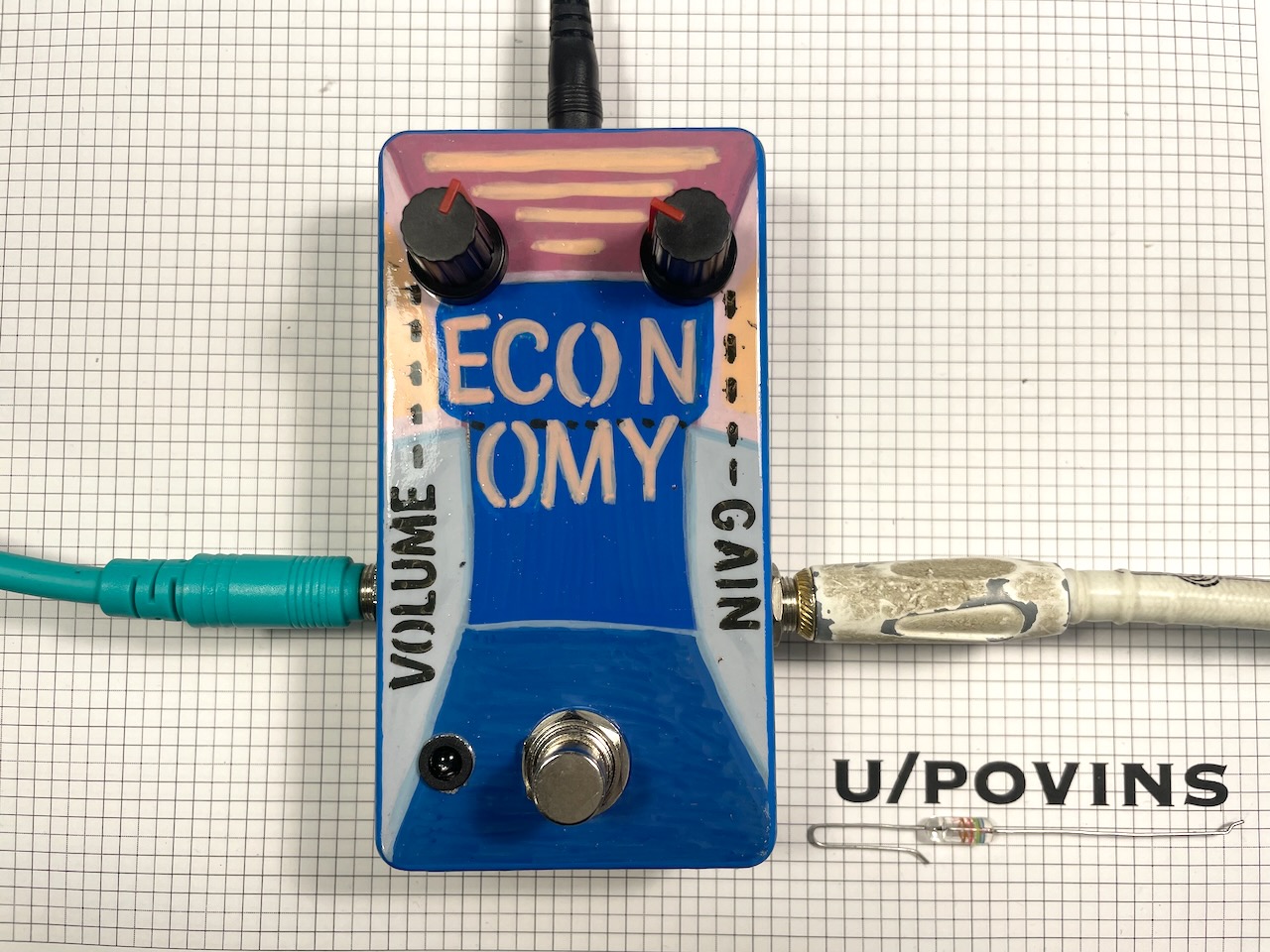
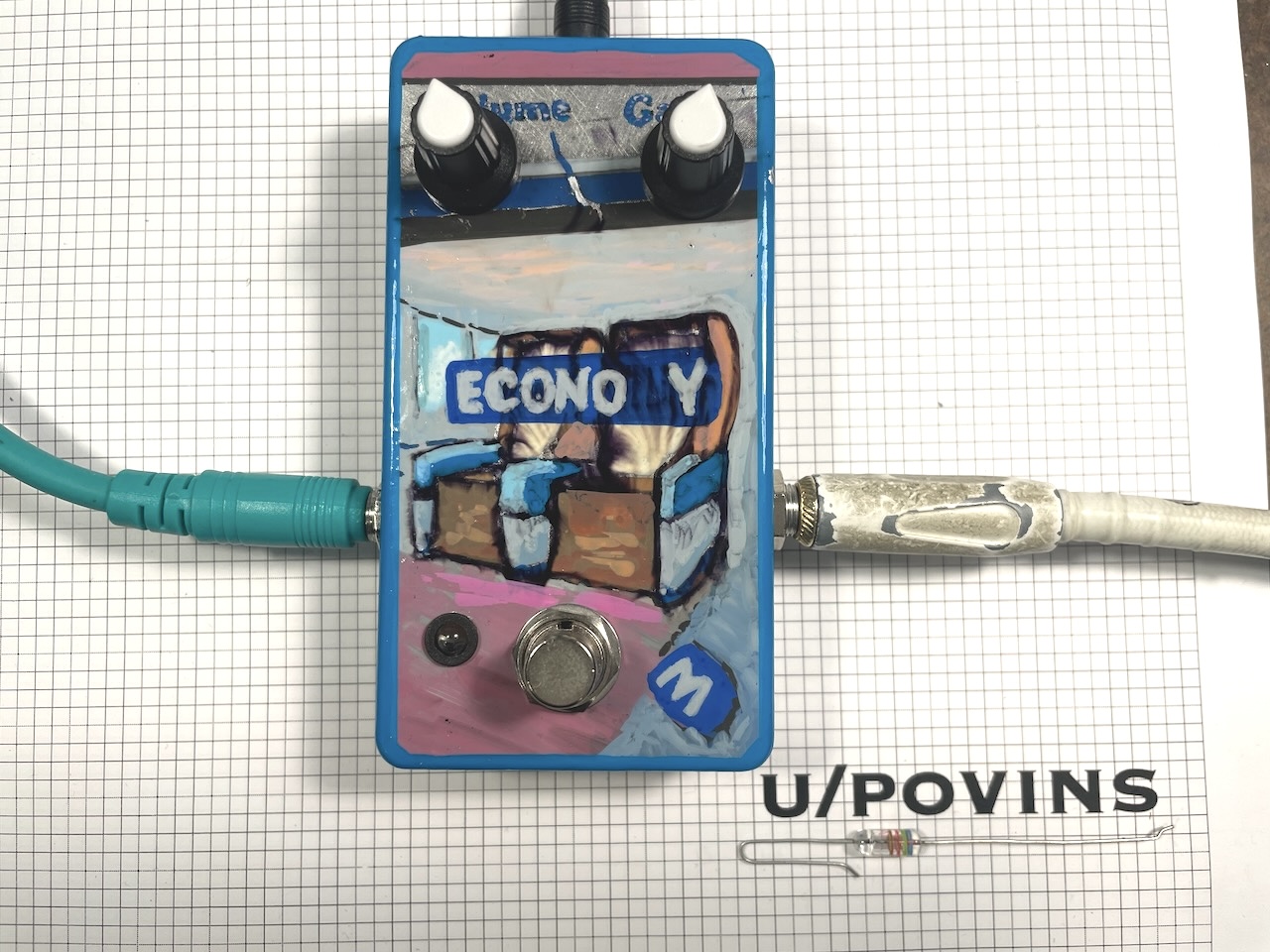
A.C. (povins) This is about as simple as they come:
- High input impedance JFET gain stage
- Volume boost when gain is low
- Gradual onset, asymmetrical clipping introduced as the gain increases
- Low output impedance BJT buffer stage
- No tone shaping (or control): EQ in is EQ out
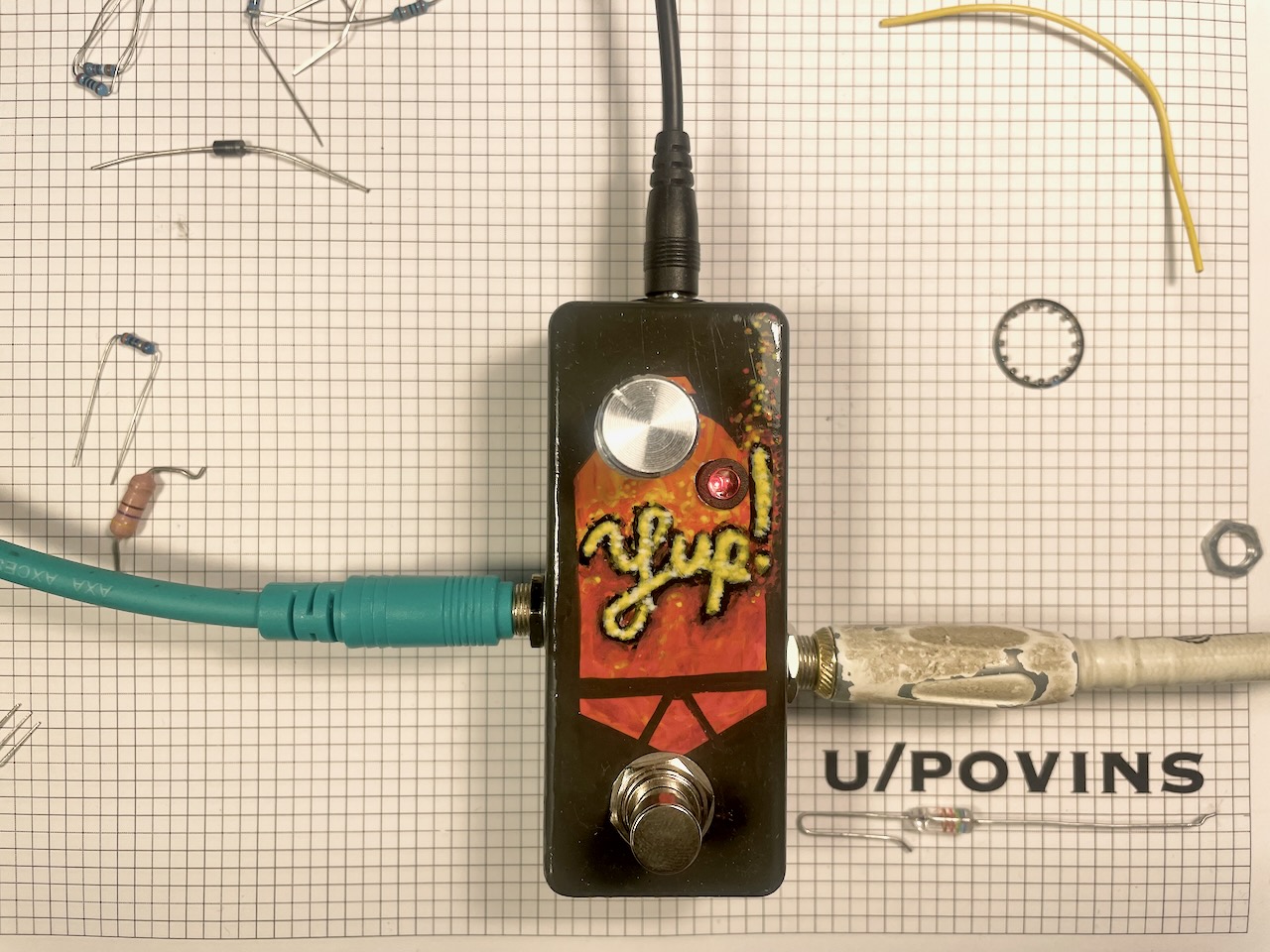
Yup! Mini Grit
One knob, BJT and LED, mid / treble booster.
A.C. (povins)
The Yup! will turn your tone to garbage — in a good way.
It’s just a pair of BJT’s that provide mid/treble heavy gain and a bit of dirt with a couple of LED’s tacked on to sharpen the edges. As a boost, it’s great for cutting through the mix in a hurry. On its own, it provides a jangly bite that is trashy as hell.
You can tell it how loud to be, but you can’t tell it what to do: it only has a volume knob.
Syndicated Overdrive
An OCD with more harmonically rich crunch and a flexible EQ.
A.C. (povins)
This is an overdrive in the spirit of the OCD, with a dual gang pot that controls clipping shape and EQ in tandem, a wider range of usable overdrive levels and a tighter bottom end.
-
There is no such thing as magic diodes. If I’m still making this pedal by the time that reel of germanium is exhausted, it’s a certainty that the same sound can be realized without them. Still, that will likely require changes to the topology, I’m not out yet, and, honestly, using old glass diodes from the 60’s is fun. ↩